Showing posts with label obscure war blogging. Show all posts

30 December 2009

Obscure War Blogging Part IV: Irish Civil War

For this week's installment, we move from a nationalist uprising in Northwest Africa to a war that was, to a certain extent, the remnant of a nationalist uprising in Europe.
While I'm not sure how obscure this war really is, I didn't know much about it, so it was obscure to me. Also, I watched The Wind That Shakes the Barley last night and wanted to learn more about what I watched.


Who?: The forces of the Irish Free State (formed by the 1922 Anglo-Irish Treaty) versus anti-treaty Republican forces.

When?: 1922-23

Toll: Somewhere in the low thousands total battle deaths, with the Republicans taking the worst of it. Civilian casualties numbers don't seem to be available. The suffering here, though, was actually worse than in the War of Independence with England that preceded the Civil War.
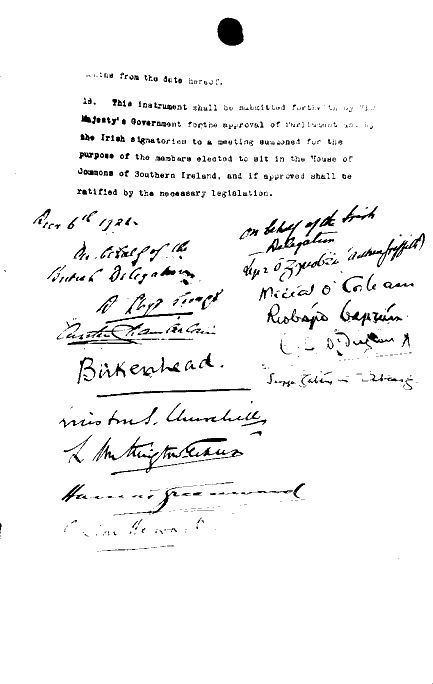
Why?: The main point of dispute between the Free Staters and Republicans was the terms of the treaty that ended the Irish War of Independence. Basically, the Republicans, including Eamon de Valera, felt that the treaty did not go far enough. The Free State was still a British Dominion and its officials had to swear an oath to the British monarch. London also maintained the ability to veto laws passed by the new Free State parliament. The treaty's opponents wanted a clean break from Britain and the establishment of an Irish republic. They were also angry that Britain retained control over Northern Ireland (via a referendum).

The Free Staters, including the famous Michael Collins, were somewhat more pragmatic about the whole thing. They saw dominion status as a path to complete independence and recognized that Britain couldn't grant complete freedom to Ireland without throwing their whole international imperial project into crisis. Mostly, supporters of the treaty wanted an end to war with Britain. Unfortunately, the civil war that would ensue would actually be more destructive.

The first Free State elections were held in 1922, with parties supporting the treaty winning the majority of seats in the new parliament. The Free State government began building an actual state apparatus, including a military to replace the IRA (this refers to the Old IRA that existed prior to the split in 1969-70).

For its part, the IRA began to disintegrate into factionalism. The majority of its members (about 2 to 1), as might be expected, rejected the treaty and the establishment of the Free State. Clashes began to break out both within the IRA itself and between anti-treaty and pro-treaty forces.

One other element that some have argued fueled the Republican campaign--addressed somewhat in the movie I referred to earlier--was class resentment. The Republicans attacked and destroyed over 100 wealthy estates controlled mainly by Loyalist and Anglo-Irish landholders during the course of the war.

Outcome: Formal hostilities broke out when anti-treaty forces occupied the Four Courts and other buildings in Dublin in April of 1922, hoping to provoke a new war with Britain and unite the quarreling factions in the IRA. This was seen as a major test for Collins and the new Free State government. London placed heavy pressure on the government to do something, and even threatened to intervene itself. Eventually, Free State forces bombarded the buildings (with British artillery no less), forcing the surrender of Republican forces.

After securing Dublin, the Free State forces, their ranks quickly swelling (given fairly widespread public support) and armed to the teeth (courtesy of His Majesty's government) quickly took control of most of the major towns in Ireland. Republican forces were quite small and poorly armed and were, for the most part, routed in open conflict. As a result, they quickly converted to guerilla tactics.

While scoring some initial successes, including the assassination of Collins, the guerilla phase of the war was not much more successful for Republican forces. There was a brief period after the killing of Collins and the death of Arthur Griffith where it looked like the Free State might collapse, but they recovered and the guerillas were mostly routed and relegated to acts of sabotage within about 8 months. Anti-treaty forces were unable to wage a proper insurgency since their support among the population was minimal (the fact that the Free State was supported by the Catholic Church was another major negative for the Republicans). This limited both their sources of supplies and their recruiting base.

The Republican campaign petered out early 1923, with many of their leaders captured or killed. A ceasefire was declared in May. Free state parties won the national elections held soon after the war.

Who Cares?: I think one of the most interesting things about this conflict is that it makes it clear that liberation movements are not just about breaking away from the metropol, but that they also have to confront what kind of state they want to create in the wake of that liberation. The hardliners in the anti-treaty movement agreed with the Free Staters that England sucked, but they fundamentally disagreed on a) what Ireland should be once England was gone and b) how to get there.

The whole thing became rather moot by the 1930s, when the anti-treatier's goal of an independent republic was realized (although, of course, the question of Northern Ireland remained unresolved). This seems to vindicate the approach taken by the Free Staters. The likely result of a Republican victory would have probably been more war with Britain and delayed independence.


As with the American Civil War, the conflict cast a pall over Irish politics for decades. Most leading Irish politicians for the next several decades were veterans of the war and politics were basically polarized along the lines drawn during the war. In fact, Ireland's two main political parties, Fianna Fail and Fine Gael, are the direct descendants of the Republican and Free State factions during the war, respectively. One particular aspect of the war that created such social strife going forward were the relatively large number of executions, both formal and summary, of Republicans by the Free State government and Free State soldiers.

22 December 2009

Obscure War Blogging Part III: Western Sahara War

For the next installment in our series, we move from the jungles of Indochina to the hot sands of the Sahara...

Who?: Morocco and Mauritania versus the Polisario Front, a national liberation group representing the Sahrawi people of Western Sahara (the Sahrawi aren't really an ethnic group, it's more of a nationalist term adopted by the people of Berber and Arab heritage living in the region).

When?: 1973-1991

Toll: About 10-15,000 total battle deaths, with Morocco, Mauritania, and the Sahrawi suffering relatively evenly. The war also precipitated a major refugee crisis among the Sahrawi.

Why?: Imperialism, nationalism, colonialism, power politics, ideology, outside interference, Arab-African tension--all of these factors played significant roles in igniting or exacerbating the war.

Spain, a minor European power by the end of the 19th century, claimed a protectorate over what became the Spanish Sahara at the Berlin Conference. It originally just claimed control over the coast, but gradually spread its control to include all of the territory. There were periodic revolts against Spanish rule throughout the 20th century. The Polisario Front, a Sahrawi nationalist group, formed in Morocco and in 1971 and launched an insurgency in Western Sahara. The Polisario raided Spanish outposts in the desert and drew major support from the local population. Spain began to negotiate its withdrawal in 1975.


Things were looking up for the Polisario, but this success was short-lived. Spain negotiated a secret deal with Morocco and Mauritania that became the Madrid Accords in 1976. The more powerful Morocco got about 2/3 of the territory and Mauritania got the other 1/3. The territory was divided despite a World Court ruling that popular opinion in Western Sahara was completely against Spanish, Moroccan, or Mauritanian control. Spain was able to maintain a stake in the territory's lucrative trade in phosphates despite its withdrawal (these resources were located in what now became Moroccan-controlled territory).

For its part, Morocco had historic claims to the area based on control by powerful ancient Moroccan kingdoms. The idea of re-establishing "Greater Morocco" had become fashionable in Moroccan politics following its independence from France.

Mauritania's position on Western Sahara was somewhat schizophrenic due to its fear of Morocco. At times, Nouakchott had favored an independent Sahrawi state as a buffer between it and its more powerful neighbor. However, when Spain withdrew, Mauritanian leadership decided that it would be best to work with Morocco rather than against it.

As with almost every conflict during this period, there was also a Cold War angle. The Polisario, which declared the Sahrawi Arab Democratic Republic (SADR) following Spanish withdrawal, enjoyed the support and assistance of Algeria (and later, Libya), which was pretty firmly in the Soviet, socialist camp during the Cold War. Not surprisingly then, the other side enjoyed the support of the US and the area's former colonial bigwig, France.

Outcome: The Polisario, based in western Algeria, continued to develop the insurgency from within Western Sahara and also began to conduct guerilla raids into both Morocco and Mauritania. The effect on the weaker Mauritania (its armed forces only numbered about 3,000) was particularly strong. The Polisario raids, combined with ethnic unrest between conscripted black Africans and Arab leadership, led to a coup in 1978 that brought down the government in Nouakchott. In 1979, Mauritania relinquished all claims to Western Sahara, pulled out, and recognized the SADR.

This was something of a pyrrhic victory for the Sahrawi, though, because Rabat immediately took control of the area formerly controlled by Mauritania. Fighting also became bogged down as Morocco built a massive, 2700 km-long sand berm--replete with mines and electronic sensors--separating Polisario controlled areas from phosphate-rich Moroccan controlled areas. This halted the success of the Polisario and separated them from much of the Sahrawi population. Maintaining the Moroccan Wall, however, was quite expensive for Morocco--the number of military forces posted there was about equal to the entire population of Western Sahara--although this was alleviated to some extent by American & Saudi aid. Raids, sniper attacks, & shelling continued, but generally at a low level.

A UN-monitored ceasefire was agreed to in 1991 on the condition that a referendum would eventually be held, but Morocco eventually withdrew. Many Sahrawi today live in refugee camps in Algeria, and Morocco doesn't want them to vote. Morocco has, at the same time, sent a significant number of settlers into Western Sahara to shore up its position. Another UN settlement attempt in 2003 spearheaded by former Secretary of State James Baker also failed.

Who Cares?: This conflict really isn't over so much as frozen. It doesn't seem like either side is going to budge anytime soon. The Moroccan monarchy has been able to generate a significant degree of national unity based on the conflict in the "Southern Provinces" and the Sahrawi in the camps in Algeria really don't want to have spent 30 years in refugee camps for nothing.

The conflict has been extremely costly for Morocco and somewhat so for Algeria. For its part, Mauritania has been quite unstable for the past several decades following the coup precipitated by the war (it just went through another coup last year). The conflict has slowed regional economic integration and made foreign investors much more wary of the area. The entire region has also become a hotbed of illicit activity, including trafficking in people and drugs, due to rampant insecurity.

One other wrinkle on the conflict is that it became a source of Arab-African tension. During the war, the SADR was generally recognized by OAU states (the precursor to today's African Union) while the Arab League tended to support Morocco's claims.

13 December 2009

Obscure War Blogging Part II: Sino-Vietnamese War or Third Indochina War


Last time we met, Pol Pot had just gotten too big for his britches and picked a fight with a much more powerful Vietnam. The next obscure war in our series follows hot on the heels of that one...

Who?: A red-hot Vietnam, fresh off of driving out the Americans, capturing South Vietnam, and showing the Khmer Rouge what for and the big, strong post-Sino-Soviet Split PRC, now in the midst of reform under the steady hand of Deng Xiaoping.

When?: 1979

Toll: The Correlates of War dataset puts the battle deaths at 21K. Official figures are sketchy, but it seems likely that both sides suffered heavy casualties. The war was fought entirely in Vietnam, so civilian casualties were probably quite high among the Vietnamese (some civilians from northern Vietnam claimed that the PLA leveled every building in their towns and villages).

Why?: While the ostensible reasons for the Chinese invasion were poor treatment of ethnic Chinese in Vietnam and Vietnam's occupation of the Spratly Islands, the broader regional and geopolitical picture is much more interesting.

As mentioned in the last entry, China was angry at Vietnam for deposing its Khmer Rouge proxies and for aligning so strongly with the USSR (Russian was now replacing Chinese in Vietnamese school curricula). China had just gotten out of its friendship treaty with the USSR and had a chip on its shoulder. It wanted to demonstrate that a) Vietnam could not dominate Southeast Asia and that b) the USSR could not protect "the Cuba of the East" from China.

At the same time, despite China's assistance against the Americans and the two states' shared communism, Vietnam and China had a long history of enmity that centered around China's historical domination of the smaller nation. This historical feud is probably best personified by the Trung Sisters, Vietnamese folk heroes who supposedly fought off Chinese invasions in the first century (riding elephants, no less).

A couple of other possible, more conspiratorial explanations for the invasion center around Deng Xiaoping's recent seizure of power in China. Some have speculated that Deng may have launched the war in order to a) point out flaws in the PLA and the need for modernization or b) distract the military while he eliminated leftist rivals in the wake of the Cultural Revolution and consolidated power.

Outcome: Chinese ground forces made a brief incursion into the northern part of Vietnam and fighting was fierce. China did not employ airpower. There were some naval engagements that China got the best of, not surprisingly. Overall, though, the plucky, battle-hardened Vietnamese military fought back fiercely against the Chinese force which has been estimated at somewhere around 100K to 200K strong. China actually employed very large forces along its border with the USSR at the same time just in case it decided to intervene on behalf of its client.

The fighting did serve to highlight serious flaws in the PLA, including antiquated technology and poor logistics. Less than a month into the invasion, China announced that Vietnam had been sufficiently punished and withdrew. Both sides spun the war as a victory. However, Vietnam continued its control over the puppet government in Phnom Penh and continued to hassle China along its border.

One small positive aspect of the conflict for China was that it demonstrated that the USSR would not intervene on behalf of Vietnam. The USSR did send arms shipments, but decided that deploying forces into the Southeast Asian theatre was impractical and that reopening the border war with China wasn't worth it. The lesson here, kiddos, is that extended deterrence is a dicey proposition at best!

Border clashes continued between the two communist states into the 90s.

Who Cares?: Once again, this war was strong proof that there was no monolithic communist bloc, although the Sino-Soviet Split and Vietnamese-Cambodian War had already made this quite clear. I'm sure, however, that such a thing continued to exist in the fevered minds of wingnuts in the US.

More interestingly, while we sometimes refer to the Korean War as "The Forgotten War" here in the US, the "Self-Defense and Counterattack Against Vietnam War," as it is referred to in China, is truly a forgotten war--no monuments, no account in textbooks, no nothing. Many veterans never really knew exactly why they had fought the war. A novel about the war almost won a national book award in China before mysteriously being removed from the competition! The actual course of the war does not square with the ruling party's national narrative of a China that has only fought to defend itself and has sought to live in peace with its neighbors, so it has simply been deleted from history.

05 December 2009

Obscure War Blogging Part I: Vietnamese-Cambodian War

This is going to be an ongoing series here at Unleashing Chiang wherein I explore various wars that most people don't know much about in an effort to educate and inform. We begin in lovely, exotic Indochina with an interstate war near and dear to my heart, the Vietnamese-Cambodian War.

Who?: Newly unified Vietnam, fresh off of its victory in the Vietnam War and Khmer Rouge-led Cambodia, right in the midst of the genocide.

When?: 1978-79


Toll:
-8-10,000 battle deaths
-humanitarian disasters on both sides; Cambodia, in particular, experienced crippling food and refugee crises

Why?: It seems especially odd that these two Southeast Asian "red brothers" would go to war, especially in the midst of what seemed to be the ascendance of communism in East Asia. What was the deal? Here are some of the causes...

To the American right, this proved that those dastardly Vietnamese commies were aggressive and sought expansion. To the left, this showed that national antagonisms could trump communist solidarity.

Hanoi and Phnom Penh had indeed quickly developed vastly divergent outlooks soon during and after the Vietnam war; for example, Pol Pot was angry that the Vietnamese chose to negotiate with the Americans. The Khmer Rouge began to purge pro-Vietnam members and discriminate against the ethnic Vietnamese in Cambodia.

The war was also a byproduct of the Sino-Soviet split. Vietnam and the Khmer Rouge were Soviet and Chinese proxies, respectively, and the two bigger powers saw the other's proxy as tools against their influence in the region. Both proxies received support from their patrons during the war.

Cambodia had long been suspicious of Vietnam's intentions, and had something of an inferiority complex. It's paranoia was somewhat well-founded though because Vietnam did intend to dominate the region.

More immediately, the two states disputed a number of islands as well as maritime borders. The crazy-ass Khmer Rouge became increasingly intransigent during the negotiations. Before long, they were conducting raids into border villages and terrorizing Vietnamese villagers. Some skirmishes broke out and Hanoi pushed for negotiations, but, well, Pol Pot was freakin' nuts. Cambodia continued to act provocatively and Hanoi decided it had had enough.

Outcome: Vietnam invaded around Christmas of '78 and quickly and easily moved on Phnom Penh. By mid-'79 Vietnamese forces controlled most of the populated areas in Cambodia. The Khmer Rouge were deposed and spent the next 15 or so years literally in the wilderness. The conquerors installed a pro-Vietnam communist regime in Phnom Penh that would rule for some time.

Who Cares?: This war is interesting for a number of reasons. First, it stopped the Killing Fields--one of the most tragic episodes in international history. So it was something of a humanitarian intervention, albeit an unintentional one.

Second, it definitely put lie to the idea that there was some monolithic communist bloc. The Russians and Chinese has already clashed up north, but this was one communist regime actually invading and deposing another.

Third, due to the odd twists of Cold War geopolitics, both China and the U.S. continued to recognize the Khmer Rouge as the legitimate government of Cambodia after Pol Pot's deposal. How traumatized and bitter were we at Vietnam for that bit of diplomatic weirdness?

Fourth, many have argued that the war played a major role in precipitating the Sino-Vietnamese War. Stay tuned for more on that one...