Showing posts with label nigeria. Show all posts

14 January 2010

Convalescing West African Leaders Emerge


I have written previously about how Moussa Dadis Camara and Umaru Yar'Adua, the junta leader of Guinea and President of Nigeria, respectively, are both out of country for medical reasons. Camara was being treated in Morocco for a gunshot wound to the head. Yar'Adua is being treated in a Saudi medical facility for an unknown illness.

Both leaders have emerged in recent days. As I mentioned in a previous post, Yar'Adua issued a statement recently confirming that he is still alive (although there has been some controversy over whether the recorded statement was actually his voice). His absence is becoming quite problematic for Nigeria. Protests recently broke out over his absence, and now the issue of transition is being taken to court.

Meanwhile, Camara has been moved from Morocco to Burkina Faso, and it seems that he is purposefully being kept out of the country while the interim junta leaders prepares for some kind of transition toward more democratic rule. Overall, it seems that Camara's absence from Guinea is much more of a positive development than Yar'Adua's, which has been almost entirely detrimental.

12 January 2010

Another Step Toward Unraveling in the Niger Delta


I've written about the possibility of renewed conflict in the Niger Delta a couple of times in the past. My last post on the topic was quite recent and was related to an attack by Delta militants on an oil facility in the region. This was one of MEND's (and related groups') principle M.O. when the conflict was in full swing, so the recent attack was a bad portent for the likelihood of continued peace in the region along with the fact that MEND said that it had "sanctioned" the attack.

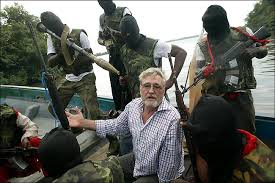
Well, the other principle M.O. for Delta militants was kidnapping oil company employees. And today's news out of Nigeria is, yep, you guessed it, that 3 Britons and 1 Colombian employed by Shell Oil have been kidnapped on their way to work in the Delta. A Nigerian who was guarding them was killed in the course of the kidnapping (it says a lot about the working conditions of oil workers in the region that they have to have armed escorts to get to work).

Hopefully, these two attacks are just a blip and not a sign of worse things to come.

As I wrote about in my last post, much of the current spike in tension is related to the health situation of President Yar'Adua. Today's hopeful news is that the president, who has been incommunicado for some time now in a Saudi Arabia medical facility, finally broke his silence in an interview with the BBC:

At the moment I am undergoing treatment, and I'm getting better from the treatment. I hope that very soon there will be tremendous progress, which will allow me to get back home.

10 January 2010

Nigeria on the Brink

While the lion's share of media coverage of Nigeria as of late has been focused on the Fruit of the Loom Bomber, the possibility of renewed conflict in the Niger Delta (and the fact that the region's troubles have been keeping about 1/3 of the country's revenues off of global oil markets) is a much more significant threat to regional and international security than terrorism originating from Nigeria. When I wrote my last post on Nigeria in mid-December, the fragile ceasefire between Abuja and MEND, the umbrella organization for Delta militant groups, was growing increasingly precarious and MEND has reportedly attacked a pipeline in the region as a warning to the government.

Well, it hasn't gotten better since then. Yesterday, a Chevron pipeline was attacked by unidentified gunmen in the Delta region. While MEND hasn't claimed responsibility for the raid, the group does say that it sanctioned the attack. These types of attacks on oil industry facilities were occurring with great regularity this past summer during the height of an offensive by the government's Delta Joint Task Force. The attacks had basically halted completely since the ceasefire (accompanied by an amnesty for militants) went into effect around the summer's end.

One of major factors exacerbating tensions here, which I alluded to in the last post but didn't discuss in detail, is the health of President Yar'Adua. To put it succinctly, it isn't really clear whether the president is actually alive and, if he is, whether he is actually well enough to run the country. It seems to be basically common knowledge in Nigeria that Yar'Adua is quite sickly. He has been receiving medical care in Saudi Arabia and hasn't appeared in public for some time now, leading to, as one might expect, all sorts of speculation, including claims that his signature has been forged on official documents.

What does Yar'Adua's health have to do with conflict in the Delta? Many of the recent peace negotiations between the government and militant groups are centered around personal assurances and promises from Yar'Adua. As the uncertainty surrounding Yar'Adua has increased, MEND has become increasingly skeptical of government promises and stepped up its hostility.

Yar'Adua's health predicament also has the potential of creating a national ethno-religious dilemma. Since its transition away from military rule in 1999, Nigeria has alternated between Southern Christian and Northern Muslim presidents (Yar'Adua is a Northern Muslim; the previous president, Obasanjo, was a Southern Christian). Yar'Adua's death would turn the presidency over the VP, the awesomely-named Goodluck Jonathan, and the Northern Muslims would lose much of their "turn" in charge.

19 December 2009

Niger Delta Relapse?

A faction of the Movement for the Emancipation of the Niger Delta (MEND) has reportedly attacked either a Royal Dutch Shell or Chevron pipeline in the delta region. The Niger Delta Joint Task Force (JTF), the security force tasked with dealing with the region, has yet to confirm the attack. MEND claims that the government is using the poor health of President Yar'Adua, who is receiving medical treatment in Saudi Arabia, to delay reconciliation talks (some officials have called for Yar'Adua's resignation due to his illness). An indefinite ceasefire has been in place since late October. If this attack actually happened, it is the first attack on an oil installation since the ceasefire was put in place.

The ceasefire came after significant conflict during the summer. The JTF launched a major operation against delta militants in May and, in return, MEND, which serves as sort of an umbrella organization for several anti-government groups, launched a relentless campaign against foreign oil company facilities in the region, with attacks occurring on a daily basis.

The Delta Conflict has been a huge drain on Nigeria, which is heavily dependent upon oil for government revenue. It is estimated that the country only produces at about 2/3 of its capacity due to these kinds of attacks and illegal oil bunkering or theft (ingenious bunkerers actually tap directly into pipelines and steal oil). Foreign oil workers have also frequently been kidnapped.

The people of the Niger Delta, such as the Ijaw, have quite legitimate grievances. They are the most resource-rich area of the country, but are plagued by poverty and underdevelopment, despite promises from Nigeria of reinvestment and development. Part of the problem is that Nigeria is that the entire oil sector is terribly corrupt. In fact, it is believed that much of the militancy and theft in the delta is actually connected to local politicians.

The campaign against foreign oil companies actually began as a non-violent movement led by Ken Saro-Wiwa, who was later tortured and murdered (Shell has been implicated in the murder, and recently settled with Saro-Wiwa's family to the tune of over $15 million). However, the movement became more and more militant as government promises never came to fruition.

This attack could mean that this dark period for Nigeria will continue indefinitely. Hopefully cooler heads will prevail.