Showing posts with label ethiopia. Show all posts

05 May 2010

Ethiopia and Eritrea Still Not BFFs


Via Sahel Blog, it looks like the two countries that fought one of the more significant interstate wars of the 90s and early oughts are back at each other's throats.

Ethiopia has elections coming up later this month (which aren't expected to particularly free or fair) and is accusing its rival to the north of attempting to destabilize the country in the run up to those elections. The government claims that "Eritrean agents" were behind a bomb that went off in Adi Haro this past weekend and that Eritrea is supporting anti-Ethiopian activity by both the Oromo Liberation Front, an Ethiopia-based ethnic nationalist group, and the notorious Somali Islamist group, al-Shabab.

Meanwhile, the Eritrean regime is now under fire from insurgent groups itself, including the fairly awesomely named Red Sea Afar Democratic Organization, that are based in and receive support from Ethiopia.

This new round of disputes between the two states seems to closely resemble the long-running (and recently ended, tentatively) Chad-Sudan feud, where each side supported anti-government rebels against the other.

06 March 2010

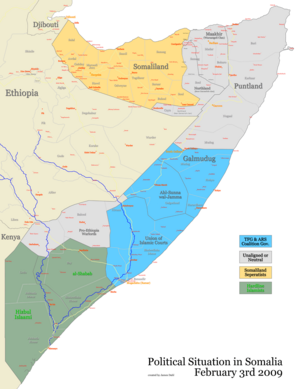
The Results of Foreign Policy Failure: Somalia


The NYT has a really interesting article up today about how the US is providing some support for an upcoming Somali TFG offensive in Mogadishu against Shabab and related groups. However, it makes only passing reference to some of the foreign policy failures of the past two decades such as the invasion in the 90s, the CIA campaign to back warlords against the ICU prior to the Ethiopian invasion, and backing the Ethiopian invasion. Helpfully though, the online article does provide links to some of those old NYT stories. This sort of gives you a clearer understanding of how the current foreign policy problem is a product of past foreign policy mistakes. It's a case study in how not to approach failed states and possible terrorist havens.

24 December 2009

Learning from Our Mistakes: Navigating Yemen

I'm gonna stick around the same region as yesterday for today's international security post...

Lots of news coming out Yemen recently as the US seems to be becoming drawn into that country to an increasing extent.--which is often lumped in with Somalia as something of a "future Af/Pak" region. Recent news reports have indicated that President Obama has personally issued orders for US forces to assist Yemeni forces with strikes and raids against the AQ-affiliate there, Islamic Jihad of Yemen. And today, news came out that a Yemeni air strike against that group may have killed the radical Yemeni cleric that the Fort Hood shooter, Nidal Hassan, was in contact with. In November, there were claims that the US signed a military agreement with Sanaa, but this wasn't confirmed by US government sources.

The beleaguered Saleh regime in Yemen may be in the most difficult position right now of any government in the world. It faces a 3-pronged attack:

1. The Houthi rebellion by members of the Zaidi sect of Shi'ism probably constitutes the biggest threat to the stability of the state right now. Recently, Saudi Arabia seems to have stepped in to support the Saleh regime against the Houthis, even by conducting air strikes across the border.

2. The periodic push for secession by southerners has re-ignited recently--South Yemen was formerly the only Marxist republic in the Middle East prior to reunification in 1990, followed by a brief civil war in '94. This has not devolved into armed conflict, but secessionist rallies have seen violence by state security forces.

3. The ongoing efforts of Islamic Jihad in Yemen.

Yesterday's post outlined 3 major lessons from US policy failures in East Africa:

the War on Terror mentality, the Bush Administration's "with us our against us" mentality, and the too-close relationship with Ethiopia


How can we apply these to the situation in Yemen in order to avoid creating the kinds of problems we have in East Africa? Some thoughts...

the War on Terror mentality, the Bush Administration's "with us our against us" mentality


With respect to this issue, I think it is best that the US needs to a) work with Sanaa only to the extent to which our interests coincide and b) realize that Yemen needs us way more than we need Yemen. As far as coinciding interests, of the three big threats to Sanaa, the only one that seems to be of any concern to the US is the third--the AQ-affiliate operating there. I don't see any compelling reason why we would need to help fight the Houthis or help Sanaa suppress the southern unrest. This would mean any assistance provided to the Yemeni forces should be clearly targeted toward the fight against Islamic Jihad in Yemen, if possible. Second, we have to realize that any one of these threats is a way bigger danger to the Saleh regime than to the US and our allies. To often we have let small client states hold our policies hostage because we inflate the dangers of these sort of things.

the too-close relationship with Ethiopia


I think either Sanaa or Riyadh could stand in for Ethiopia here. Just because Yemen is cooperating with us, as did Ethiopia, is no reason to unconditionally support all of their policies. The Saleh regime isn't particularly democratic or humane. We can leverage our assistance to try to improve this, but, again, there is no compelling reason to support the campaign against the Houthis or the southerners. And the Saudis may be important strategic allies, but our security and economic relationship doesn't mean we have to support their meddling in northern Yemen.
23 December 2009

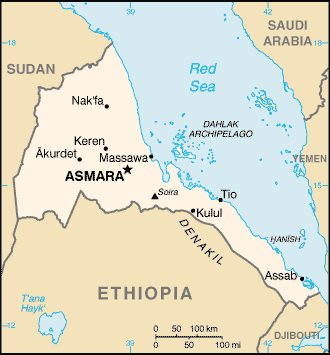
How Did Eritrea Become a Villain?

This post is related to Frosty's recent post.

With the young state of Eritrea poised to join the ranks of UN-sanctioned international pariah states such as Sudan, North Korea, and Iran due to its support of Al-Shabab in Somalia, it is worth considering how it got to this point. Mark Leon Goldberg at UN Dispatch provides some background:

It all began in 2000, when Eritrea and Ethiopia, exhausted from war, decided to end their bloody border dispute by submitting to international arbitration. When the arbiters in the Hague handed down their ruling, they awarded the key disputed territory to Eritrea. End of story, right? Wrong. Ethiopia simply refused to withdraw and a stalemate ensued.

A changing international scene did not help things. The Clinton administration was instrumental in forging the original settlement between Ethiopia and Eritrea. But by the time of the arbitration ruling, September 11 had already occurred and the Bush administration was focused on leveraging the support of Ethiopia on terrorism issues in the Horn of Africa. Accordingly, the United States was reluctant to press Ethiopia to abide by the ruling.

From an Eritrean perspective, you can see how this might be unsettling. Asmara had agreed to binding international arbitration, but the international community was apparently unwilling to enforce the ruling. Caught in the middle were a few thousand UN Peacekeepers along the border, acting as a buffer between the two armies.

As Eritrea's understandable frustration with the international community grew, Asmara began to lash out in patently unhelpful ways. It kicked out UN Peacekeepers by blocking their shipments of petrol and food; made threatening statements aganst top American officials; attacked neighboring Djibouti; and supported a faction opposed to the internationally-backed Transitional Federal Government of Somalia.


Asmara has also moved closer to Tehran in recent years, according to some reports.

So what lesson do we take away from all of this? It looks like the situation is somewhat similar to as well as closely related to the problems Frosty diagnosed in Somalia. The War on Terror mentality, the Bush Administration's "with us our against us" mentality, and the too-close relationship with Ethiopia seem to have screwed us here, just as in Somalia. By backing our "ally" Ethiopia unconditionally, just as in its invasion of Somalia in 2006, and ignoring the World Court ruling, we undermined international norms and institutions and created backlash that ended up being even more problematic (just as removing the ICU in Somalia led to the rise of Shabab). I guess Ethiopia is a loyal and submissive client, but it doesn't seem like the relatively authoritarian Zenawi regime is our best option as an East African proxy.