Additionally, it was a nice gesture for Vice-Chairman of the Central Military Commission of China to lay a wreath at a memorial for those who died in 9/11.
27 October 2009
Good thinking!
More evidence for why Gates is the best SecDef I can ever remember. Pushing for military cooperation with the second greatest military force in the world should be a no-brainer, and yet I'm sure it will be controversial for some.

Regionalism and Transnationalism
I tend to be a big fan of the power of institutions to achieve good effects in the world, if only in making it easier for states to cooperate and share information. However, while the EU makes a great case for how this can work, I'm skeptical of the ability of any other region, particularly ASEAN+, to do the same.

This is a region with a dizzying difference in incomes (far more than the original EEC, I believe, with Singapore having 150x the per capita GDP of Burma), with very diverse political structures (from democracies in the Philippines, South Korea, and Japan, to autocratic one-party systems like China and Vietnam, to family autocracies like Singapore, and even a military junta in Burma), and with very different identities (Christian, Muslim, Buddhist, Confucian, and atheist, not to mention the extremely large number of ethnicities and nationalities). This project will have every single problem the EU had, and then some. Some of the players even want to include the US and other non-Asian countries. I expect this to be a nice idea, floated around, but then quietly set aside.
This is a region with a dizzying difference in incomes (far more than the original EEC, I believe, with Singapore having 150x the per capita GDP of Burma), with very diverse political structures (from democracies in the Philippines, South Korea, and Japan, to autocratic one-party systems like China and Vietnam, to family autocracies like Singapore, and even a military junta in Burma), and with very different identities (Christian, Muslim, Buddhist, Confucian, and atheist, not to mention the extremely large number of ethnicities and nationalities). This project will have every single problem the EU had, and then some. Some of the players even want to include the US and other non-Asian countries. I expect this to be a nice idea, floated around, but then quietly set aside.
The Economist on North Korea
The Economist this week points out once again the utter horror that is living in North Korea. Those reading this blog know that this is an issue dear to my heart. No one should be shocked to learn about work camps, forced starvation, or mass executions. The state is collecting most of its revenues from giant extortion rackets, threatening people with any of the above unless they pay for protection.
The second option given was to offer "apparatchiks and the elite education abroad". However, that is already happening, if only illicitly or in China. Kim's youngest son went to school in Switzerland; most of the rest of the high officials went to school in China. There is no love lost for the DPRK system within the Chinese university system (especially by the real Communists who dislike the monarchical style of the North Koreans). Moreover, those let out of the country will only be those with the utmost loyalty to the regime. While there may be some overall softening and socializing of leaders, I am unsure how much it would do to change the regime. On top of that, I can't imagine it would do anything to help the people on the ground. (Never mind all the work that would have to be done first, including restoring diplomatic relations.)
Unfortunately, the recommendations of the Economist are laughable. The article suggests that the West should beam "radio broadcasts that offer another reality to the state-manufactured one". This neglects the fact that the US is already beaming in VOA and Radio Free North Korea. It also neglects the fact that North Korea jams most stations, and also fixes all radios to only pick up state approved stations. Owning a radio that could even pick up these illicit radio broadcasts would be a massive risk for anyone willing to do so.
My heart bleeds as much as anyone's for those trapped in the evils of the North Korean regime. However, there needs to be some recognition that there is a strong limit on what the outside world can do. North Korea is not a country that's likely to change just because the outside world engages in a little propaganda or tries to push it.
Beyond that...there is a little worry in the back of my mind. I am still worried about the possible aftereffects of the utter collapse of the North Korean state. I'm not saying that American/Western pressure will bring the state down, but I think it may be more likely right now than the kinds of reforms we would like.
UPDATE: Ha! Looks like at least one actual important pundit (Michael Crowley) has come to the same conclusion, if only a few days later.
22 October 2009
Interesting scuttlebutt
 There are changes afoot on the Korean peninsula, but it doesn't seem like any grand change in the overall situation.
On the Southern side, the US has once again pledged to defend South Korea, going so far as to say that South Korea is under the US nuclear umbrella. I'm not sure anyone really doubted that fact, but having the SecDef say it definitely gives it more oomph. More important was the side-by-side agreement Gates and ROK Defence Minister Kim Tae-Yong showed. At the same time, the timetable for full ROK command of its own forces in wartime is still on track for 2012. This is great news for the Korean state, which has long felt slighted by the provisions of previous agreements that put ROK forces under the command of the US, but I have to admit to some slight worry over C&C issues should war break out at that point. I'm hoping that the US and ROK forces are strongly putting together all the joint-planning systems they will need to coordinate.
More importantly, however, in that same article SecDef Gates says that the US and ROK forces are planning for what is probably the likeliest scenario, a full break-down in internal order in DPRK. There were no details, but I'm glad to know that our leaders have realized how likely that is, and how deleterious.
This is especially important now that the succession plans in DPRK are apparently becoming more dicey. Apparently Kim Jong-Il is not happy with how his son, Kim Jong Eun has been handling his responsibility over the military. Moreover, North Korean officials who visited South Korea several months ago to attend the late President Kim Dae Jung's funeral were exceptionally solicitous, and took a harangue by President Lee Myung-bak very courteously, promising to try to stop northern provocations.
This worries me, in some ways. A strong North Korea could be disastrous, particularly if it decided it was strong enough to attack South Korea. On the other hand, a very weak North Korea could collapse entirely. Moreover, North Korea is not East Germany; I don't think it will meekly accept merger with South Korea on its own terms, at least not with the Kim family in charge. This is a monarchy, not a Communist country, and so the preservation of the monarchy becomes vastly more important. There is no way for a "new generation" of leaders to come in except through a literal dynastic change, and then that leader will have more interest in the preservation of that system than a man who worked his way up from the ground floor. (Yes, this is an argument based on constructed identity, not raw power. So sue me.) While there have been kings who have liberalized, I'm not sure it will be possible in North Korea without unleashing a tidal wave, ending in the dissolution of the DPRK and the rest of the world picking up the pieces.

This is what will be unleashed on the region. I know that merely being polite does not mean that North Korea is weak, but along with rumors of succession issues on top, it makes me worry. It also makes me doubly glad that Gates and Kim Tae-yong are working on that issue now.
20 October 2009
China might yet get a carrier!
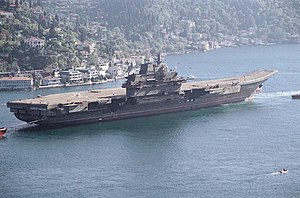
It looks like China is finally working on getting the Varyag up and running, at least according to the New York Times. Though it seemed, at first, to be a silly notion for China to spend so much time and money developing an aircraft carrier, it makes more sense to me now. The country feels the need to project power into (at least) the Straits of Malacca, and preferably out to the "American defense belts".
What I worry about now is American/Western over-reaction. America has 11 carriers, all of which more than match this one. No other state has more than one carrier, and we also have more "mini-carriers" (VSTOLs) than all other states combined. One little carrier, particularly for a country without much of a navy otherwise, won't change that much.
More importantly, it won't really affect our security issues with China. A carrier is impractical for threatening its immediate neighbors, like Taiwan or Japan. Chinese missiles and planes can reach them already. If anything, it is merely a show of force. It's not something to worry overmuch about.
14 October 2009
SCO Meeting results in nothing in particular
 It should be obvious by now, but the SCO seems increasingly like a big show, rather than an actual threatening anti-American alliance.
 China and Russia are actually suffering in recent months from the scourges the SCO was set up to deal with (extremism, separatism, and terrorism). Was the Uyghur situation discussed? Not at all. The North Caucasus problem? Nope.
The only concrete result of this meeting is that the Central Asian countries will get $10b in credit from China, to help combat the downturn. While I'm sure there is some kind of security aspect to that, it's very weak work from a hyped security summit.
Guys--if you want to balance against "hegemonism," you'll need something stronger than that.
12 October 2009
Unpopular view

But, really, at what point does it become not worthwhile to fight an insurgency anymore?
I'm not talking about Afghanistan here. Thailand has been fighting (off and on) an insurgency in its extreme southern provinces (which are Muslim and Malay, instead of Buddhist and Thai) for about a century now. Today, the security forces raided a school due to concerns about indoctrination into insurgency there.
And it seems they came up with something. There were in fact books on how to be suicide bombers, and they are interrogating 60 students. It could represent a real breakthrough, but I'm very skeptical.
It is said that insurgency is a long slog and very difficult to do. What does Thailand gain by keeping these three provinces? It is not like the separatism would spread to the rest of Thailand; these provinces are unique in many ways in Thailand. These are the only places that are majority Muslim or majority Malay. In fact, this is a former independent country that then-Siam annexed in the early 20th century. It is not like other provinces would be encouraged to do the same thing (unlike China).
I do not know what, other than pride, Thailand gets out of continuing to hold these provinces. However, no one ever wants to give up and accept that losing sometimes is less costly than winning.
Hearts and Minds in Xinjiang

There is a reason why the rule of law is so precious in any country, even China. Sometime yesterday, 6 men were convicted and sentenced to death for their parts in the riots in Xinjiang in July. Of course, there are many people (particularly in the Muslim community in China) that are convinced it is a sham.
If the Chinese (and particularly the Chinese Uyghurs) had a real belief in the fairness of the justice system, it is likely that these riots never would have happened. But, because no one does, it is likely that the riots will resurface again, particularly after a quite likely flawed trial condemns more Uyghurs to death. If the people believed it was a fair trial, then they would be more likely to accept the outcome. Because they do not, more violence could result.
This is the problem with the Chinese approach on so many fronts. They have been trying to build up soft power in many parts of the world (especially with the Confucian centers that have been opened around the world), they still ignore many of the actual roots of soft power, even with their own citizens. This is not a way to build legitimacy; it merely erodes it further. (The same happens when they lash out against the Dalai Lama for going to give religious care to Taiwanese.)
Without fixing these problems of legitimacy, the Chinese will never end the general violence and distrust in Xinjiang.
08 October 2009
Oh, and speaking of Taiwan...
Just for the coolness factor:
I do believe this would be the ultimate deterrent against any action across the Strait.
(h/t War is Boring)
I do believe this would be the ultimate deterrent against any action across the Strait.
(h/t War is Boring)
Subscribe to:
Posts (Atom)
